Monday, October 1, 2012

Some Are Born Great...


Review: The Master

"Say your name." 
"Freddie Quell." 
"Say it again."
"Freddie Quell." 
"Might as well say it one more time, just to make sure you know who you are."
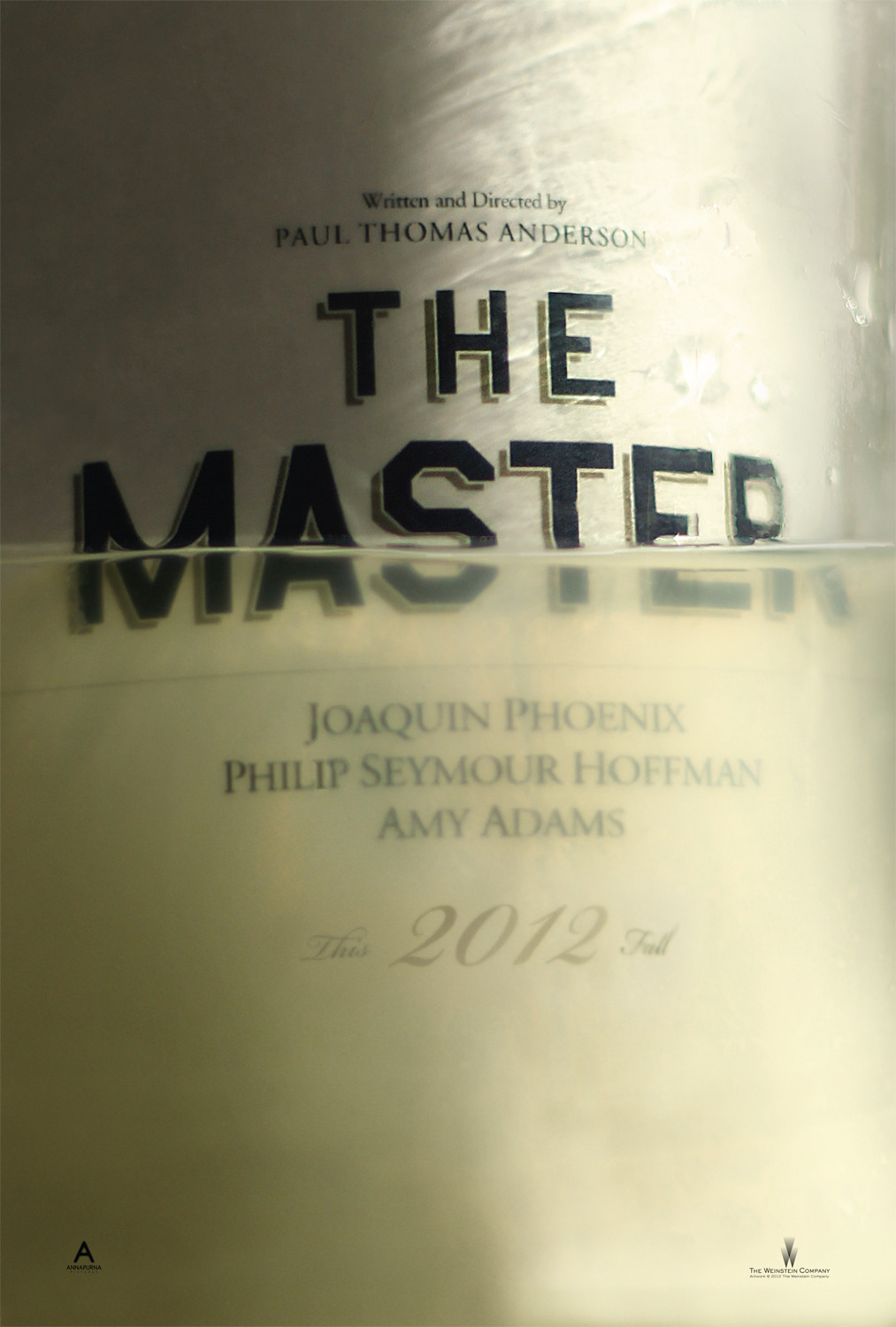
There's no turning back once Freddie (Joaquin Phoenix) sits for informal processing with Lancaster Dodd (Philip Seymour Hoffman). The two men face each other over a tape recorder, Dodd leveling softballs ("Say your name.") followed by more searching questions ("Are you thoughtless in your remarks?"). He speaks with an amiable pomposity, as if giving a Sunday morning sermon. The processing scene is pivotal to The Master, and it's fun to watch: a mental tennis match between Hoffman's confident prodding and Phoenix's unpredictability.

From their meeting, Dodd senses something in Freddie: an otherness? Or that the boy is so easily malleable?  To say he's more instinct than intellect is an understatement. He's a drained vessel, far from heroic, lacking in social conduct. We laugh at his base stupidity: he humps, then curls up to, a sand mermaid made by sailors on the beach. And Phoenix gives an exhausting, highly external performance, his posture strained, his lip fixed in a sneer. Freddie's such an extreme that I wondered how The Cause could lure ordinary thinking people.

Hoffman is the best he's ever been, as effortlessly authoritative as Orson Welles in his early days. Amy Adams may be the real manipulator as his always watchful wife, or (and I suspect this more) full-on Stockholm, a loyal lapdog that Dodd has indoctrinated. Paul Thomas Anderson, writer and director, has assembled the parts together. Is his carefully calibrated direction like Dodd's rhetoric, fooling us into thinking he's made a great movie? As Adams says, maybe it's no more than "a grim joke."

Freddie doesn't reach any great self-realization. His final scene with Dodd simmers, without the volcanic crucifixion that ends Anderson's There Will Be Blood. Hoffman singing "On a Slow Boat to China" as a goodbye feels deliberately arbitary. The Master reenacts welcome-home war films like The Best Years of Our Lives  (1946) and strips them of their patriotism, their hollow Messages and Meanings. We wait with Freddie to figure out where we're going; and when we arrive, what have we seen?

For Your Consideration: Best Picture; Best Director (Paul Thomas Anderson); Joaquin Phoenix, Philip Seymour Hoffman (Actor); Amy Adams (Supporting Actress); Jonny Greenwood (Score). 

Saturday, August 18, 2012

TCM! Hire Me as Your Copyeditor!

Dear Robert Osbourne:

We all love TCM. But Bette Davis and Joan Crawford aren't giving you the stink-eye for no reason.


Friday, August 10, 2012

Oscar Forecast: 2013


Are you in a summer movie slump? I’ve seen many recent releases, and I’m still waiting for one movie I really want to write about. The Dark Knight Rises came closest. So instead of retiring this space until November, how about an early Oscars forecast?

"Will any of us be nominated?"
Moviemakers, take note: Your chances hinge on what the studio spends, how many parties you attend in the New Year, if the public feels you’re overdue. Sure, the actual movie matters. If Harvey Weinstein says it matters.

These are my Best Picture nominee predictions a healthy seven months early. However many there will be:

1. Lincoln
One of two highly anticipated films that couldn’t possibly—but will—live up to the excitement. Never underestimate a biopic starring Daniel Day-Lewis, helmed by Steven Spielberg. Sally Field, they really like you! And if War Horse could make the cut…

2. The Master
Believe. The. Hype. After Paul Thomas Anderson’s There Will Be Blood, you bet everyone in Hollywood is ready for his next chance at bat.

Sunday, August 5, 2012

So Live and Laugh at It All

Review: Uncle Vanya
City Center, New York
July 28, 2012


Cate Blanchett is a woman of uncanny beauty. Her director, cast, and even husband (the translator) know it, too, judging by the Sydney Theatre Festival staging of Uncle Vanya. As she enters the stage, cloaked in a headscarf, sunglasses, and cream-white dress that evoked Grace Kelly, it's hard not to feel a little reverent. Her wardrobe and coiffed appearance announce, yes, a star who knows she's a star; but she's also considerably older than her character Yelena Serebryakova, who should be 27. Blanchett's approach to Yelena begins with careful elegance, when she comess to the estate of her retired husband's late wife. We soon see her crisp, statuesque appearance fall away into fumbling sexuality and even goofiness. These mannerisms are an artifice for Yelena, maybe trying hard to set back the clock, afraid to let loose and let go.


Director Tamás Ascher throws Blanchett onto a set caked in sweat that seems to close in more each act. The family maintaining the estate all ramble about their boredom while their lives waste away. I'd imagined Uncle Vanya would be full of the melancholy and lingering disappointment I associate with Ingmar Bergman's films. Instead, the audience laughed throughout. The cast didn't push for humor; this wasn't a Vanya for Must-See-TV at 8 p.m. But Andrew Upton's translation lets us laugh (with that laugh of understanding) at the Serebryakova family's follies. We can relate to the shame of throwing ourselves at someone and being rejected.


This isn't grand tragedy, just drama born from ennui. Blanchett moves about the house like a swan, exotic and perhaps dangerous if you get too close. She lures two men, first Uncle Vanya himself (Richard Roxburgh), who at 47 feels he has thrown away all his chances. Even his attempts to seduce Yelena are sad, and well-executed by Roxburgh, the soul of this production. Roxburgh makes his self-pity and disgust extraordinarily funny. And who could resist a shot at the virile town doctor, Astrov? The excellent Hugo Weaving is a force of life as Astrov, shaking up the boredom of this old estate, bellowing about, kissing Yelena with unanticipated suddenness. 


I wasn't sold on Hayley McElhinney's interpretation of Sonya, the professor's daughter who suffers from being not beautiful. McElhinney seemed more simple-minded than plain, and felt overshadowed by Blanchett's male stage partners. But the pleasures of my first experience with Uncle Vanya--and Chekhov in any form--were many. The Sydney mounting steps around tragedy, bypasses comedy and melodrama, and settles into a balance like life itself.

Saturday, June 16, 2012

Out of the Past

Review: Other Desert Cities
Booth Theater, New York
June 9, 2012


Last weekend in New York, we went to Other Desert Cities the night before the Tony Awards. If there were an award for ensemble acting, attention should be paid to Joe Mantello's lacerating production. I'm glad I caught the show in New York, with five go-for-broke performances that filled in the cracks of a solid but often familiar play.


Well-off Republicans Polly and Lyman Wyeth (Stockard Channing, Stacy Keach) are spending Christmas in Palm Springs for the first time in years with her alcoholic sister Silda (Judith Light) and their children: courtroom reality TV producer Trip (Thomas Sadoski) and formerly hospitalized novelist Brooke (Elizabeth Marvel), who's overcome crippling depression. But Polly is quick to suspect that Brooke's newest "novel" is something far more personal and damaging to the family. Sure enough: it's a memoir of her other brother, who committed suicide.


Stockard Channing anchors the cast as the caustic, no-nonsense matriarch who once made Nancy Reagan cry at dinner. She will keep the Wyeths' reputation at any cost, even if it means disowning her daughter. Channing's always had a quick wit and sharp tongue, employed here to harrowing (even villainous) effect. As her husband, a former Western movie-star, Keach plays a man overshadowed by his wife and his spectacular cinematic death scenes. It's to Keach's credit that Lyman, so out of touch and haunted by his past, doesn't recede into the background. Neither does Sadoski, sincere as the do-no-wrong son who tries not to take sides.


Marvel's Brooke is on the edge, but she's a strong warrior against Channing's Polly. Her histrionics, though, sometimes feel out of sync with the other actors, pushing the emotional instabilities we already know Brooke suffers from. She's best in her scenes with Light, who starts as comic relief but reveals her determination to have the book published. Silda appears dimmed by the years, even if her outward wisecracks say otherwise.


Jon Robin Baitz's play is in the tradition of Who's Afraid of Virginia Woolf?, from the acerbic jabs to the enclosed setting, with the family trapped out in the open desert landscape, isolated but unable to hide. And like Virginia Woolf, everyone has their juicy outburst, and unconscionable secrets are excavated. But Other Desert Cities depends upon its twist ending to be satisfying drama, a revelation that warrants more aftermath than we see. How did they forgive each other? How did they move on from the unthinkable? There's plenty of acid along the ride, but I left wondering if we'd already been down this road.

Search This Blog