Tuesday, December 29, 2009

I Love Cinema Italiano, But This Isn't It

Review: Nine

The New York Times and The Washington Post ripped it apart. The holiday theatergoers shelled out for Avatar instead. The Golden Globes, unsurprisingly, nominated it, but they nominate every musical. So why does Nine not add up?

1. Nine is not Chicago. It has an arthouse theme: Guido, nearing fifty, suffers from director's block. Existential crisis doesn't sell tickets.
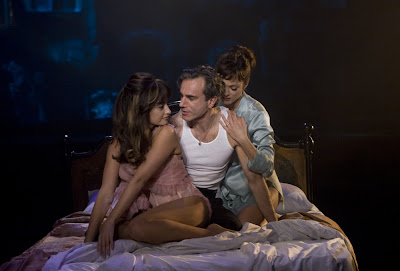
2. It's full of arthouse actors, most of whom are quite good. Marion Cotillard is sensationally moving in the truncated role of Guido's wife, Luisa. But even Johnny Depp couldn't turn Sweeney Todd into a runaway smash.

3. Maury Yeston's score for Nine is post-Sondheim: minimalist accompaniments to each song, eighth notes repeating endlessly. Movie critics and audiences unused to this style of composition say it's not memorable.

4. So Yeston wrote a splashy pop song for Kate Hudson, an American journalist. But "Cinema Italiano" sticks out like a nun at Mardi Gras. Did the filmmakers think we unsophisticated lot needed an American to guide us through Italian neorealism?

5. And why choose the songs they did? Judi Dench rolls her rs with vigor in "Follies Bergeres," but it's shoehorned in. And including more songs for Daniel Day-Lewis' Guido might have endeared him to us. As he plays it, Guido has little charisma or sense of humor.

6. The first number that lands, all too late, is Cotillard's "My Husband Makes Movies," stunningly filmed and acted. Even the erotic "A Call from the Vatican" feels off in Penelope Cruz's hands. (She's appealingly grotesque elsewhere as Guido's trashy mistress.)

7. Rob Marshall's gimmick, to ground the musical numbers in performance settings, made sense in Chicago because the characters were stage performers. Here, the soundstage cutaways do not justify why they sing in the first place. Could Nicole Kidman not sing at the real fountain rather than the fountain on Guido's soundstage? Whose head are we in: hers or Guido's?

8. The screenwriters don't trust us. The beautiful "Unusual Way" is chopped up with dialogue, even in the middle of verses. No wonder audiences can't remember the songs. Kidman is lovely as Guido's muse, Claudia, but her singing sounds studio-engineered; same with Day-Lewis and Cruz. Maybe the film would have been better without songs.

9. But then again, that already exists: it's called 8 1/2.
Friday, December 18, 2009

The Great American Songbook: "It Might As Well Be Spring"

Written by: Richard Rodgers, Oscar Hammerstein II
First recorded by: Louanne Hogan

The wind chill below zero degrees changed my mind fast: bye-bye "White Christmas," and in with springtime. Rodgers and Hammerstein were fond of season songs ("Younger than Springtime," "June is Bustin' Out All Over"). They won the 1945 Best Song Oscar for this charmer. A mopish Iowa lass pines at her windowsill, taking in the summer heat, for the calendar to turn backward:


They opened their stage career together with the rousing Oklahoma!, and Rodgers and Hammerstein contribute many more hearty all-American songs into State Fair, their first film musical. But "It Might As Well Be Spring," ten minutes in, imbues the film with an underlying uneasiness. Just listen to Rodgers' clever oscillating melody.

The first line, "I'm as restless as a willow in a windstorm," is a series of sighs (on "restless," "willow," and "windstorm") that monotonously droop to the same tonic note. But Rodgers animates the second line, mirroring the words with sprightly upward leaps: "I'm as jumpy as a puppet on a string." Even then, the leaps descend the scale wearily. When the melodic line repeats ("Like a nightingale"), the singer deflates on the words "without a song to sing." The end addresses the song's desperate ebb-and-flow:

But I feel so gay, in a melancholy way,
That it might as well be spring.
It might as well be spring.
So laissez-faire, that phrase "might as well." As with "White Christmas," the anxiety of World War II feeds into what could have been a straightforward romance song. Notice how Hammerstein slips it in discreetly: "Hearing words that I have never heard / From a man I've yet to meet."

Louanne Hogan premiered this song by dubbing Jeanne Crain in State Fair. But it found radio success with Dick Haynes, her on-screen brother. Then came the usual recording suspects: Frank Sinatra, Ella Fitzgerald, Johnny Mathis, Doris Day. In the 1962 State Fair, a young Pamela Tiffin (who longs for a "boy" she's yet to meet) sang it while swinging on fence rails like an audition for The Wizard of Oz.

Tuesday, December 8, 2009

The Great American Songbook: "White Christmas"

Written by: Irving Berlin
First recorded by: Bing Crosby, 1942

My Christmas present to readers is to commence my new blog project: commentary on some of the classic American songs of the twentieth century. These songs have withstood the test of time. (Though some artists find "Single Ladies" the best song of all time, it's not blog fodder yet.)

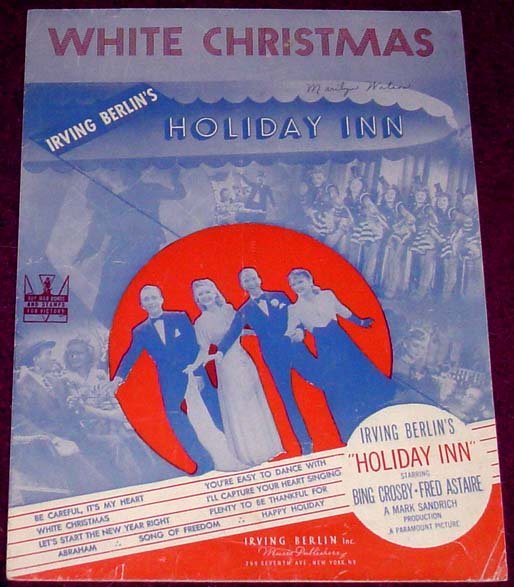
A week into December, what more appropriate song to open with than Irving Berlin's "White Christmas"? Berlin's holiday tune has sold more singles and more sheet music than any other song. The song was composed around 1940 and worked into Holiday Inn, still winning the Oscar for Best Song of 1942. Bing Crosby sings the ballad at the piano, teaching his protege what would become iconic music:


Apocryphal stories suggest that Berlin had more trouble writing a Christmas song than for the other holidays in the film (I wonder how easily "Abraham" came, performed in blackface on Lincoln's Birthday!). What we hear today on the radio was re-recorded by Crosby in 1947, with the original 1942 single lost. In 1954 he sang it again as a duet in White Christmas, designed around the song's popularity.

Berlin composed a simple 32-bar structure: one chorus, repeated with the same lyrics. The rhyme scheme changes between quatrains, from ABCB (and internal rhyme in the third line: "Where the treetops glisten and children listen") to ABBB. The nostalgic longing for the snow-blanched seasons of yesterday was a vital sentiment in World War II. The Christmas cards written could be letters sent to loved ones fighting in Europe. "White Christmas" combines a remembered dream with the wish, but not the certainty, that it will come true. Yet less melancholy runs through the lyrics and the gently unfolding chromatic melody than in other war-time singles like "I'll Be Home for Christmas" or "Have Yourself a Merry Little Christmas."

Barbra Streisand was one of the first to record, for her 1967 A Christmas Album, Berlin's verse:

The sun is shining, the grass is green,
The orange and palm trees sway.
There's never been such a day
In Beverly Hills, L.A.
But it's December the twenty-fourth
And I am longing to be up north.
Bred on Tin Pan Alley syncopations, Berlin doesn't write often about L.A. glamour, and for good reason. Few of the published verses to his songs are performed. Hard to see Streisand as a Beverly Hills shopgirl, but her fondness for offbeat story songs suits her here. Still, most popular versions - including The Drifters' bluesy take in 1954 - cut straight to the chorus.

"White Christmas" lasts, after all these years, because the song is hard to oversell. Berlin could have raised the octave at the end but scored the ending lower. And there's the musical break in "Christmases" during the final line, "And may all your Christmases be white," like a catch in the singer's throat. A emotional but unsentimental conclusion to a song that endures.

Read Roy J. Harris from the Dec. 5 Wall Street Journal for more on this very song.

Tuesday, November 24, 2009

Have Yourself a Merry Little Turkey

Christmas does not start until Black Friday. Call me stubborn, but I do not want to weave through Hallmark decorations or sit in coffee shops hearing "Chestnuts roasting..." unless Thanksgiving has come and gone. This year, as is appropriate, we will have exactly one month for carols. November 26 through December 25. And if you croon "Away in a Manger" or "The Twelve Days of Christmas" after the New Year, more power to you. Epiphany (when the Wise Men met Jesus) lies twelve days later, on January 3.

I had "Silver Bells" stuck in my head this week; what a nuisance. Octogenarian Santas may already be jingling outside Wal-Marts, and the weather's turning toward the chill. But the lyrics state, "It's Christmastime in the city," and that is a falsehood before Turkey Day. We are about to endure thirty days of full-frontal, last-chance-for-holiday-shipping, buy-it-now marketing. Unnecessary to jumpstart the madness.

Greeting card vendors and music sellers need some product to carry them after Halloween, in the waning days of autumn. I propose we compose some Thanksgiving songs. A holiday stuffed with food and family deserves some musical dressing as a complement. (Perhaps from the Cranberries.) Forging new Thanksgiving songs this late in the game would be impractical. Let's reconstitute the Christmas songs already trapped in our heads so that they will be seasonly apropos:
O Come All Ye Family (to "O Come All Ye Faithful")
O come all ye fatties,
Gorge on mashed potatoes,
O come eat, O come eat
All Aunt Bea's kitchen.
Come and we'll roll thee
Home, you king of gluttons.

Happy Turkey to You (to "The Christmas Song")
Turkey roasting on an open fire,
Jack, your uncle, nibbling on your yams.
Tiny tots with their seats at the kids' table,
And folks dressed up like anachronistic pilgrims.

No More (to "The First Noel")
The first Thanksgiving, Columbus did say,
Was to certain poor Indians in slaughter as they lay.
No more, no more, no more colonization,
Born is the king of eradication.

Friday, November 13, 2009

Good Vibrations

Review: In the Next Room or the vibrator play
Lyceum Theatre, New York
November 11, 2009


Women of the 1880s who showed symptoms of hysteria went to their doctor to induce a paroxysm. In the new age of electricity, no longer illuminated by candles, these women experienced a newfound sensation, or even two at once. A new scientific invention, ridding their womb of hysteria confined within, invoked in tandem pain and pleasure.

So it was that the vibrator came into existence. Sarah Ruhl's new play In the Next Room paints this scene to forward her views of women's progress. When plans changed during my day trip to New York, I scooped a ticket on the basis of the actors, Lincoln Center Theater, and indubitable curiosity. Ruhl's previous play Dead Man's Cell Phone dealt with metaphysical questions of life, love, and limbo. In the Next Room, I hoped, would ground her in the specifics of time and place.

But her main character, Mrs. Givings, jars with the costume drama around her. Laura Benanti's housewife, unable to feed her newborn properly, yearns to connect with her child and with her husband, the paroxysm-curing doctor. Though her character harbors proto-feminist desires, Benanti acts like she's just stumbled in from Mad About You. Ruhl encourages this modern portrayal with choice vernacular: Wednesday is "smack in the middle of the week"; Mrs. Givings loves to "walk walk walk" through the garden. She is a lifeforce but an anachronistic one.

As Dr. Givings, Michael Cerveris stays period. In his steady portrayal of a scientific mind, he does not wink at us like Benanti, even when he calmly times his patients' three minutes of paroxyical ecstasy. He unveils a boyish vulnerability as he gradually warms to his wife's need for intimacy. Chandler Williams makes an impression as a European artist given new sight with the Chattanooga Vibrator. (Yes, men received medical stimulation too. Don't ask where.)

Ruhl's strengths are comedy and sentiment. Benanti's charming monologue on her child's birth ("and then he tried to eat me") manages both. But Ruhl's play overall is a provocative outline of ideas. She doesn't know how characters should enter, so they all misplace their scarf or gloves, as in a farce. And she nudges characters to reveal truths more modern than their setting. Did women really open up to each other about the vibrations? Why would the midwife, once a God-fearing woman, connect the machine to sexual relations with her husband?

In the Next Room
is rooted in whimsy and screwball comedy; don't think too hard about its social implications. Like its electric star, the play induces sensations of both pleasure and discomfort.

Search This Blog